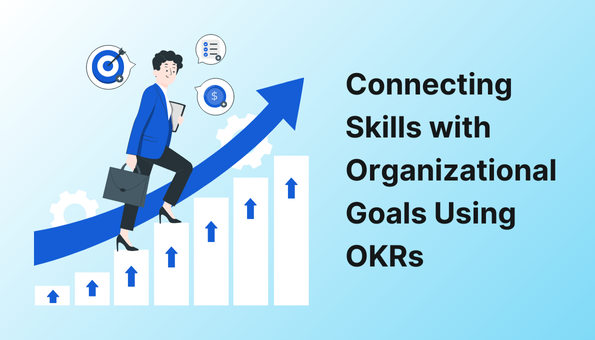
A proven method for achieving organizational alignment is through the use of Objectives and Key Results (OKRs). By connecting skills development to organizational goals, companies can foster a culture of continuous improvement, drive engagement, and ensure that individual growth contributes directly to business success. 🌟
Understanding OKRs: A Brief Overview
OKRs (Objectives and Key Results) are a goal-setting framework designed to promote focus, alignment, and measurable progress within organizations. They consist of two main components:
- Objective: A clear, qualitative goal that sets the direction (e.g., “Enhance customer satisfaction”).
- Key Results: Quantifiable outcomes that define success for the objective (e.g., “Increase Net Promoter Score by 10 points”).
This framework helps organizations break down high-level goals into actionable steps, ensuring that every team member understands their role in achieving these objectives.
🔍 Statistic: According to Harvard Business Review, companies using structured goal-setting frameworks like OKRs are 40% more likely to exceed their growth targets.
The Importance of Aligning Skills with Goals
Employees are at the heart of any organization’s success. However, skills development often occurs in isolation, disconnected from broader organizational objectives. By aligning skills with OKRs, organizations can:
1. Enhance Goal Achievement: Ensure employees have the capabilities needed to achieve strategic objectives. 🎯
2. Boost Engagement: Employees are more motivated when they see how their growth impacts the organization. 📈
3. Drive Continuous Improvement: A structured approach to skills development fosters a culture of learning. 🔄
Steps to Connect Skills with Organizational Goals
1. Identify Core Skills Needed for Success
Start by analyzing your organizational goals and determining the critical skills required to achieve them.
- For example:
Goal: “Increase customer satisfaction by 20%.”
Skills Needed: Empathy, problem-solving, and customer service expertise.
💡 Insight: A Gallup study found that 87% of employees are more likely to stay with an organization that invests in their development.
2. Create Skill-Based OKRs
Develop specific OKRs focused on skill-building. For instance:
- Objective: “Improve team competency in advanced data analytics.”
Key Result 1: “Complete three advanced Excel training sessions.”
Key Result 2: “Implement two data-driven project solutions by Q3.”
3. Align Skill Development with Organizational Objectives
Integrate skills-focused OKRs into broader organizational goals. For example:
Organizational Objective: “Launch a successful digital marketing campaign.”
- Team OKRs:
“Develop expertise in Google Ads by completing certification courses.”
“Generate 500 qualified leads from Google Ads campaigns.”
4. Incorporate OKRs into Performance Reviews
Use performance reviews to track progress on skill-based OKRs, ensuring accountability and recognizing achievements. 🏆
Tools and Technologies to Support Skill Alignment
1. Performance Management Systems: Use platform like AssessTEAM to track OKRs. 🛠️
2. Learning Management Systems (LMS): Integrate training platforms like Udemy for Business or Coursera to offer skill-building resources. 🎓
3. Analytics Tools: Leverage AI-driven insights to identify skill gaps and predict future needs. 🤖
Challenges and How to Overcome Them
- Measuring Skills Progression
Skills can be intangible and hard to quantify. Address this by: Using metrics such as certifications earned or project outcomes.
Incorporating peer and manager feedback into evaluations. - Employee Resistance
Frequent assessments can feel burdensome. Mitigate this by: Clearly communicating the benefits of skills alignment.
Offering support through mentorship or coaching. - Integration Complexity
Aligning skills with goals can be challenging in large organizations. Simplify this by: Using cross-functional OKRs to ensure collaboration.
Breaking objectives into manageable, team-specific goals.
Real-World Examples: Case Studies
Case Study 1: E-commerce Industry
Scenario: A mid-sized e-commerce company aims to improve its customer satisfaction score by 20%. Organizational Objective – “Enhance customer support quality.”
CEO-Level OKRs:
Objective: “Achieve 20% higher customer satisfaction ratings.”
Key Result 1: Implement a company-wide customer support training program.
Key Result 2: Reduce average resolution time by 30%.
Team-Level OKRs:
Train all support staff in advanced conflict resolution techniques.
Implement a ticket prioritization system to improve efficiency.
Skills-Level OKRs:
Customer service representatives to complete a conflict resolution certification.
Improve individual response time metrics by 25%.
Outcome: Through targeted skill development and clear OKRs, the company achieved a 22% increase in customer satisfaction within six months. 📊
Case Study 2: Healthcare Industry
Scenario: A healthcare organization aims to reduce patient wait times by 15% in its outpatient clinics. Organizational Objective – “Streamline clinic operations.”
CEO-Level OKRs:
Objective: “Reduce average patient wait time to under 15 minutes.”
Key Result 1: Deploy a new scheduling software across all clinics.
Key Result 2: Ensure 100% compliance with new scheduling protocols.
Team-Level OKRs:
Train administrative staff on new scheduling software within two months.
Develop a system to monitor and flag scheduling bottlenecks.
Skills-Level OKRs:
Administrative staff to complete proficiency assessments in scheduling software.
Reduce individual scheduling errors by 20%.
Outcome: The organization achieved a 17% reduction in patient wait times and improved patient satisfaction scores. 🏥
Case Study 3: Technology Start-Up
Scenario: A technology start-up focuses on accelerating its product development cycle by 25% to meet market demands. Organizational Objective – “Increase development efficiency.”
CEO-Level OKRs:
Objective: “Launch three new product features by Q3.”
Key Result 1: Ensure Agile adoption across all development teams.
Key Result 2: Reduce development cycle times by 25%.
Team-Level OKRs:
Certify all developers in Agile methodologies by the end of Q2.
Conduct bi-weekly sprint reviews to track progress.
Skills-Level OKRs:
Developers to complete Agile certification courses.
Improve individual task completion time metrics by 15%.
Outcome: The start-up achieved a 28% faster product development cycle, leading to increased market share and customer acquisition. 🚀
The Long-Term Benefits
- Stronger Workforce: Employees with aligned skills are better equipped to contribute to organizational success.💪
- Improved Retention: Employees are more likely to stay with companies that invest in their growth. 🏢
- Greater Organizational Agility: A skilled and goal-aligned workforce can adapt more quickly to market changes. 🔄
By connecting skills with organizational goals using OKRs, companies can bridge the gap between individual development and strategic priorities. This alignment not only drives performance but also fosters a culture of engagement, learning, and shared success. 📈